

Writing a Will in England and Wales
Written by the AWAY Wills Team | Last updated June 2026
A Will is a legal document that sets out what happens to your estate when you die. Your estate includes your money, property, possessions, and any other assets you own. In England and Wales, you must be 18+, write your wishes down and sign it with two witnesses present. A Will lets you decide who inherits what, appoint Executors, name a Guardian for children under 18, and avoid the fixed rules of intestacy that apply if you die without one.
In England and Wales, a Will only takes effect after death. While you are alive, it has no legal impact and can be changed at any time.
What happens if I die without a Will?
Dying without a Will can make things very complicated for those left behind.
A valid Will allows you to:
Decide who inherits your estate
Appoint Executors to carry out your wishes
Name a Guardian for any children under 18
Record funeral preferences
Reduce delays and uncertainty for the people you leave behind
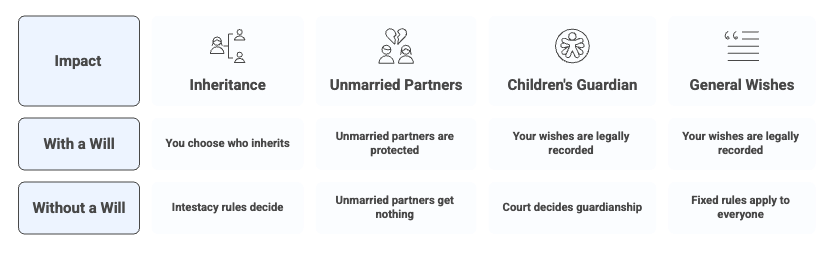
Without a Will, these decisions are made according to the rules of intestacy - fixed legal rules that often do not reflect modern family life.

Dying without a valid Will in England and Wales means your estate is dealt with under the rules of intestacy. These are fixed rules that apply the same framework to everyone, regardless of your actual circumstances.
They do not account for unmarried couples or partners, blended families, or personal wishes. In many cases, the people closest to you have no automatic legal right to inherit your estate or decide anything, despite your personal wishes.
A Will is the only way to replace those default rules with your own decisions.
→ Read more on intestacy rules in our our complete guide: Who Needs a Will?

Do I need a Will?
A Will is not just for the wealthy or the elderly. You should consider writing one if you:
Have children or dependents
Are in a long-term relationship but not married or in a civil partnership
Own or share property
Have step-children or chosen family you want to provide for
Want clarity over who is responsible for your affairs
If any of those apply to you, you need a Will matters.
→ Read our complete guide: Who Needs a Will?
What happens if I die without a Will?
Dying without a valid Will in England and Wales means your estate is dealt with under the rules of intestacy. These are fixed rules that apply the same framework to everyone, regardless of your actual circumstances.
They do not account for unmarried partners, blended families, or personal wishes. In many cases, the people closest to you have no automatic legal right to anything.
A Will is the only way to replace those default rules with your own decisions.
→ See detailed intestacy rules and scenarios here.
Dying With a Will vs Without a Will: What's the Difference in England and Wales
What are the legal requirements to make a Will?
To write a legally valid Will in England and Wales, a Will must:
Be made by someone aged 18 or over
Be made voluntarily and with mental capacity
Be in writing
Be signed by the person making it
Be witnessed by two independent witnesses, present at the same time
If any of these requirements are not met, the Will may be invalid.

How does the process of writing a Will work?
Writing a Will does not have to be complicated, but it does need to be done correctly.
At a high level, you will need to:
Decide what you want to happen to your estate
Choose who should inherit your estate (no matter the size)
Appoint one or more Executors
Name a Guardian if you have children under 18
Sign and witness the document correctly
Some people write their own Will. Others prefer professional support. What matters most is that the final document is clear, legally valid, and reflects your actual wishes.
The 5-step process for writing a valid Will in England and Wales

If you want to have a conversation where we explain things in plain English and avoid legal jargon, we would love to help.
What Is a Family or Mirror Will?
As an individual, you can of course have a personal Will, but often couples can benefit from a family Will or a Mirror Will where a couple have a shared estate and their instructions for their estate and dependants are similar.
It is worth noting that if you have an individual Will, or a previous family, mirror or joint Will and get married or remarried - any previous Will is revoked in England and Wales.
Read more about the need for a Will in our Guide: Who Needs a Will.

Is a Family Trust the same as a Family Will?
While they are similar in terminology, a Family Trust is very different from a Family Will.
A Family Will comes into effect only after one of the parties in the family Will passes away and usually offers straightforward instruction on the distribution of a simple estate.
A Family Trust is a legal arrangement that can take effect immediately or when you pass away, allowing for greater control of the estate and tax benefits.
Do I need a Lawyer to write a Will?
No, it might surprise you to learn that you don’t technically need a lawyer or a Will writer to write a valid Will in England and Wales.
However, using a professional to write your Will is worth considering if you have any level of complexity in your family or estate arrangements:
You are in a long-term partnership like an unmarried couple or same sex couple
You are in a second marriage, a blended family or have step-children
Your estate is subject to Inheritance Tax
You have your own business and wish to Will it to your children
You own property abroad
We’re registered with the Society of Will Writers so you can have confidence in our understanding and legal execution of your preferences in a Will.
When should I update my Will?
A Will should be reviewed whenever your circumstances change. Common reasons to update include:
Having children
Buying or selling property
Getting married, separated, or divorced
Changes in who you want to inherit
Changes in your choice of Guardian or Executor
Reviewing every three to five years is a sensible habit and one that we will remind you of, if you’re a client of ours.
Guardianship
If you have children under 18, your Will is the only place in England and Wales where you can formally record who you want to care for them if both parents die.
→ Read our full guide to choosing a Guardian

This guide reflects current law and practice in England and Wales and is reviewed regularly to ensure accuracy.